High-volume work
Teams spend time reading, classifying, copying and reconciling information across operational systems.
Bring controlled AI automation to document-heavy pharma operations.
Bring controlled AI automation to document-heavy pharma operations. Start with one measurable process and design automation around the systems and controls already in place.
Teams spend time reading, classifying, copying and reconciling information across operational systems.
Policies, SOPs, documents and case history are difficult to find and apply consistently.
Enterprise automation must know when to act, when to ask for human review and how to preserve an audit trail.
Regulatory documentation, quality operations, medical information, submissions support and enterprise knowledge.
Extract, classify, summarize and validate information from structured and unstructured documents.
Move requests through AI classification, business rules, approvals, integrations and exception handling.
Ground answers in approved enterprise sources and preserve source context for users.
Regulatory document extraction
Quality-event support
Medical-information triage
SOP assistant
Submission content preparation
Controlled search
A representative pattern can be adapted to your process, systems, approval model and governance requirements.
Keep AI connected to the systems, knowledge and controls that already run the business.
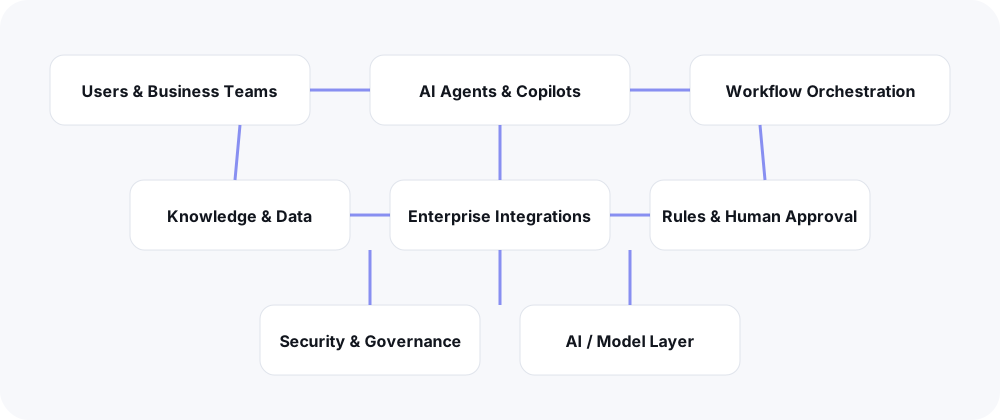
Architecture is illustrative. Final design depends on data classification, identity, integration requirements, model choice, latency, risk and deployment constraints.
Reduce repetitive handling and give teams more capacity for judgment-heavy work.
Reduce unnecessary handoffs and accelerate the parts of a process that can be safely automated.
Capture workflow status, exceptions, decisions and measurable operational signals.
AI should operate within clearly defined permissions, data boundaries and approval paths.
Use enterprise identity and role-aware access so users and agents only reach permitted information.
Use approved knowledge sources, retrieval controls and evaluation to reduce unsupported answers.
Route high-risk, low-confidence or policy-sensitive cases to people and retain an audit trail.
Customer-specific case studies will be added as production engagements are approved for publication. We do not invent customer results.
Baseline volume · handling time · exception rate · automation rate · turnaround time · quality/error rate · user adoption · operating cost.
Explore Case Studies →Bring a repetitive workflow, document-heavy process or knowledge problem. We will help define the opportunity, baseline the work and shape a practical AI path.